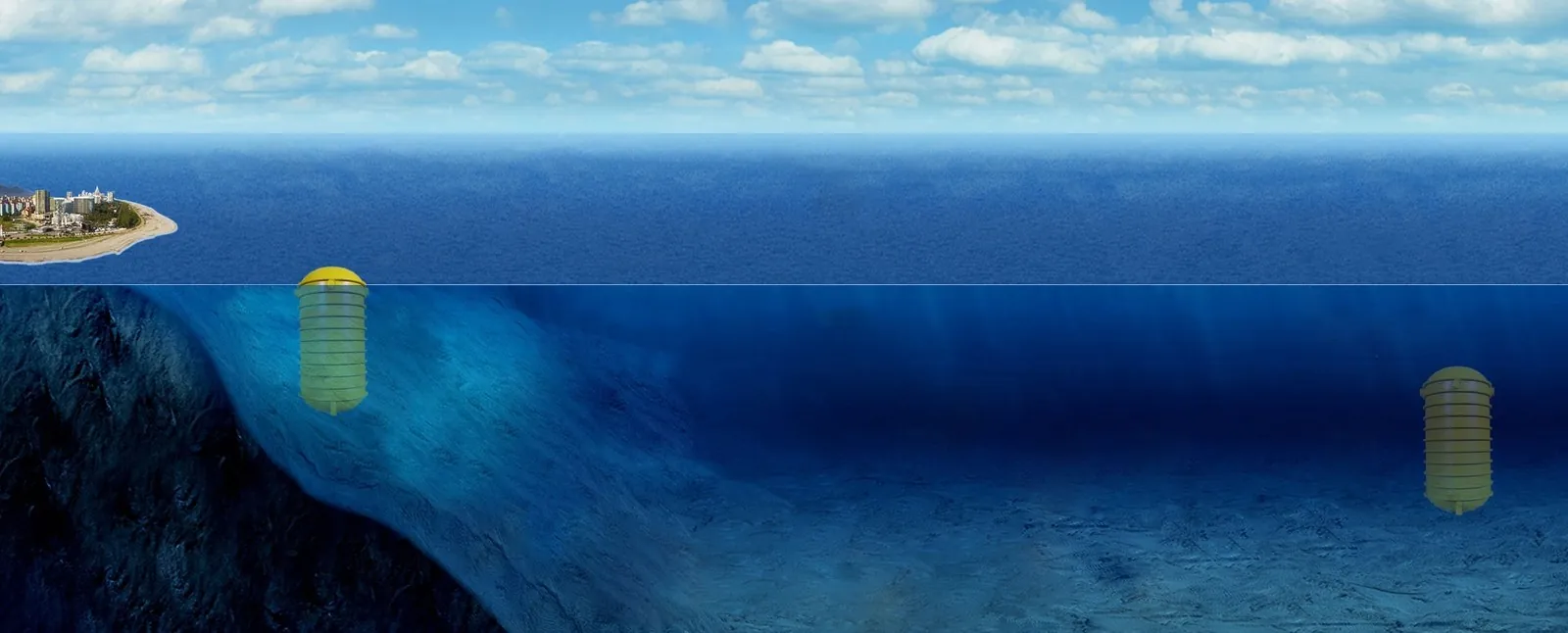
Cross-section of a semi-submerged DeepWater installation off a coastal city

Right here, Just there.

We produce electricity

You see nothing?  You hear nothing!! That's exactly the point...

HCORI develops a technology
to produce energy for every
region of the world.

It is an innovative
hydroelectric infrastructure
based on gravity in the
marine environment.

Every maritime area is a
potential market for DeepWater.

The project

An idea born in the engine room

Origin

Roland Irdor, founder of HCORI, spent his early career on the propulsion systems of the French Navy, trained at the École de Maistrance. That practice is where the DeepWater insight came from: producing electricity not by capturing a natural flow such as wind, waves or currents, but by engineering a controlled water drop inside a semi-submerged structure.

The consequence is immediate. The resource is available along almost every coastline and large lake in the world. Production is designed to be continuous and to remain operational whatever the weather conditions, day and night, summer and winter.

Protection

The principle was formalized in Paris and is covered by an intellectual property program targeting 15 patent families, spanning the platform architecture, the hydraulic circuit and the integration of on-board applications. The program is run with a specialist firm.

The details of the mechanism are not disclosed publicly. They are shared with industrial partners and investors under contract.

Founding team

HCORI France SAS was incorporated in Paris to carry the project through to industrialization. Around the founder, a small team brings together naval engineering, power electrical engineering and industrial architecture. These people have worked together for many years. Recruitment for the first senior engineering positions is under way.

  • Roland IRDOR Founder & President

    Former petty officer of the French Navy, École de Maistrance. Maintenance of naval propulsion systems, then design and installation of chilled-water production systems.

  • Jean-François RICHARD Electrical architecture

    Electrical engineer, formerly with a major French power utility. On-board electrical systems and power distribution.

  • Misha KRAMER Structural design

    Senior architect, formerly with a leading international practice. Complex structures and large-scale works.

  • Karl TERIIPAIA Architecture & fit-out

    Design and fit-out of industrial spaces. Organization of the platform's technical volumes and circulation.

  • External adviser Fluid dynamics

    A fluid dynamics specialist supports the team on the blowing system and flow behavior.

  • Senior engineering Now hiring

    Technical direction, certified offshore engineering, hydraulic and systems engineering. Key first-year positions are open.

Technology readiness

The operating principle was verified in 2024 through scale-model testing in an instrumented basin in Paris. The next phase of the program will take the technology to validation in a representative environment, ahead of the industrial demonstrator.

  1. TRL 3 Achieved in 2024

    Experimental proof of concept through a campaign of 12 tests run over 16 months, on instrumented 2.70 m scale models submerged to a depth of up to 3 m. The basin tests characterized the hydraulic and hydrodynamic behavior of the system and experimentally confirmed the expected physical phenomena.

  2. TRL 4–5 Next phase of the program

    Modeling and digital twin of the platform, reduced-scale instrumented test bench, qualification of compression components with manufacturers, design review with a marine certification body.

  3. Demonstrator Later stage

    Industrial-scale pilot unit in real sea conditions, opening the commercial deployment phase and series production.

HCORI France is currently raising the funds to finance this program. The full investor file is shared on request. Get in touch.

DeepWater

One semi-submerged industrial platform positioned across four strategic infrastructures.

The technical core hosts the application of your choice. Data center, desalination unit or electrolyzer: the configuration is set before construction, according to your project.

Machine hall of a power generation facility

Power generation

The hydroelectric power of tomorrow

Decarbonized, modular and unobtrusive power.

DeepWater is a semi-submerged vertical-drop hydroelectric infrastructure.

Designed for rapid industrial deployment, it targets 40 to 240 MW depending on the target configuration, with a design capacity factor of 95 to 98%. Its architecture is built on 8 independent units, which maintain partial output while one unit is under maintenance.

Key figures

  • 40 to 240 MW of installed capacity per plant, depending on the target configuration.
  • 8 independent hydroelectric units, maintaining partial output while one unit is under maintenance.
  • Up to 30 MW per unit in the 240 MW target configuration.
  • Up to 2.10 TWh of decarbonized electricity per year at full theoretical output.
  • Production designed to run continuously, 24 hours a day, 365 days a year, independent of sunlight and of the day/night cycle.
  • Modular architecture, matching installed capacity to the energy needs of the site.
  • Marine or lake deployment, as close as possible to major centres of electricity demand.

Innovation at the core of the infrastructure

Beyond power generation, DeepWater offers a unique strategic advantage: a protected technical core of 2,000 m².

  • Optimized space: 8 levels dedicated to integrating your assets.
  • 24/7 performance: continuous operation, a low visual profile and strongly limited noise emissions.
  • Agile maintenance: permanent secure access without interrupting operation.

A solution replicable at scale, suited to many deep marine and lake environments.

Server aisle in a data center

Turnkey data centers

The DeepWater plant includes 2,000 m² of available space for custom-built edge data centers, deployable in many regions of the world.

Each site is sized for approximately 320 server racks at 12 kilowatts, close to 4 megawatts of IT load, depending on the target configuration.

The infrastructure is powered by renewable electricity produced on site and cooled by chilled water at 8 °C produced locally.

The solution is autonomous, reliable and secure.

Turnkey data center in 24 months

HCORI France aims to offer a complete solution, from design to commissioning, delivering an operational turnkey data center in 24 months, according to the requirements and constraints of the host site.

Client benefits

  • Sovereign, local data hosting
  • Renewable electricity produced directly on site
  • Reduced dependence on the power grid
  • Control and better predictability of energy costs
  • Cooling by chilled water produced locally
  • Lower energy consumption dedicated to cooling
  • Reduced carbon footprint of digital infrastructure
  • High availability of digital services
  • Modular and scalable infrastructure
  • Deployment as close as possible to digital demand
  • Suited to high-performance computing and artificial intelligence workloads
  • Compliance with environmental and decarbonization targets
  • Data center delivered turnkey in 24 months
Piping of a reverse osmosis desalination unit

Turnkey fresh water production

DeepWater integrates a reverse osmosis desalination unit powered directly by the electricity produced on site.

It is sized to produce between 8,000 and 12,000 m³ of fresh water per day, up to 4.38 million m³ per year at full theoretical output.

This production is designed to be local, continuous, autonomous and low-carbon.

  • It puts the available space at the core of the infrastructure to work.
  • It turns a passive volume into a strategic production asset.
  • It durably strengthens water supply security for the territories served.
  • It creates a unique synergy between renewable energy and water resources.
Hydrogen storage vessels across several levels, technician on an inspection round

Turnkey green hydrogen

The DeepWater plant includes 2,000 m² of available space for custom-built water electrolysis units, deployable in many regions of the world.

Each site is sized to host a 10 to 20 megawatt electric unit, producing 4 to 9 tonnes of green hydrogen per day, up to 3,200 tonnes per year at full theoretical output.

This output directly addresses the decarbonization needs of industry, heavy transport and energy networks.

The green hydrogen is stored, used locally or exported as required.

Contact

Address
HCORI France
128 rue La Boétie, 75008 Paris, France
LinkedIn
LinkedIn